

Mean Corpuscular Volume in HFE p.C282Y/p.H63D Compound Heterozygotes With High Iron Phenotypes: Clinical and Laboratory Associations
DOI:
https://doi.org/10.14740/jh2155Keywords:
Age, Alcohol, Heavy alcohol intake, Serum ferritin, Transferrin saturationAbstract
Background: The aim of this study was to define the relationships between mean corpuscular volume (MCV) and 12 clinical and laboratory variables in HFE p.C282Y (rs1800562)/p.H63D (rs1799945) compound heterozygotes.
Methods: We retrospectively studied self-reported non-Hispanic white adult compound heterozygotes with transferrin saturation (TS) > 50% and serum ferritin (SF) > 300 µg/L (men) or TS > 45% and SF > 200 µg/L (women) who participated in primary care-based screening. In post-screening evaluations, we excluded participants with anemia, pregnancy, or medication use that increases MCV. We defined heavy alcohol intake as > 28 g/day in men and > 14 g/day in women. We determined associations of MCV with the following clinical and laboratory variables: age, sex, body mass index (BMI), diabetes, daily intakes of heme, non-heme, and supplemental iron, daily intakes of alcohol, swollen or tender second/third metacarpophalangeal (MCP) joints, reports of therapeutic phlebotomy, TS, and SF.
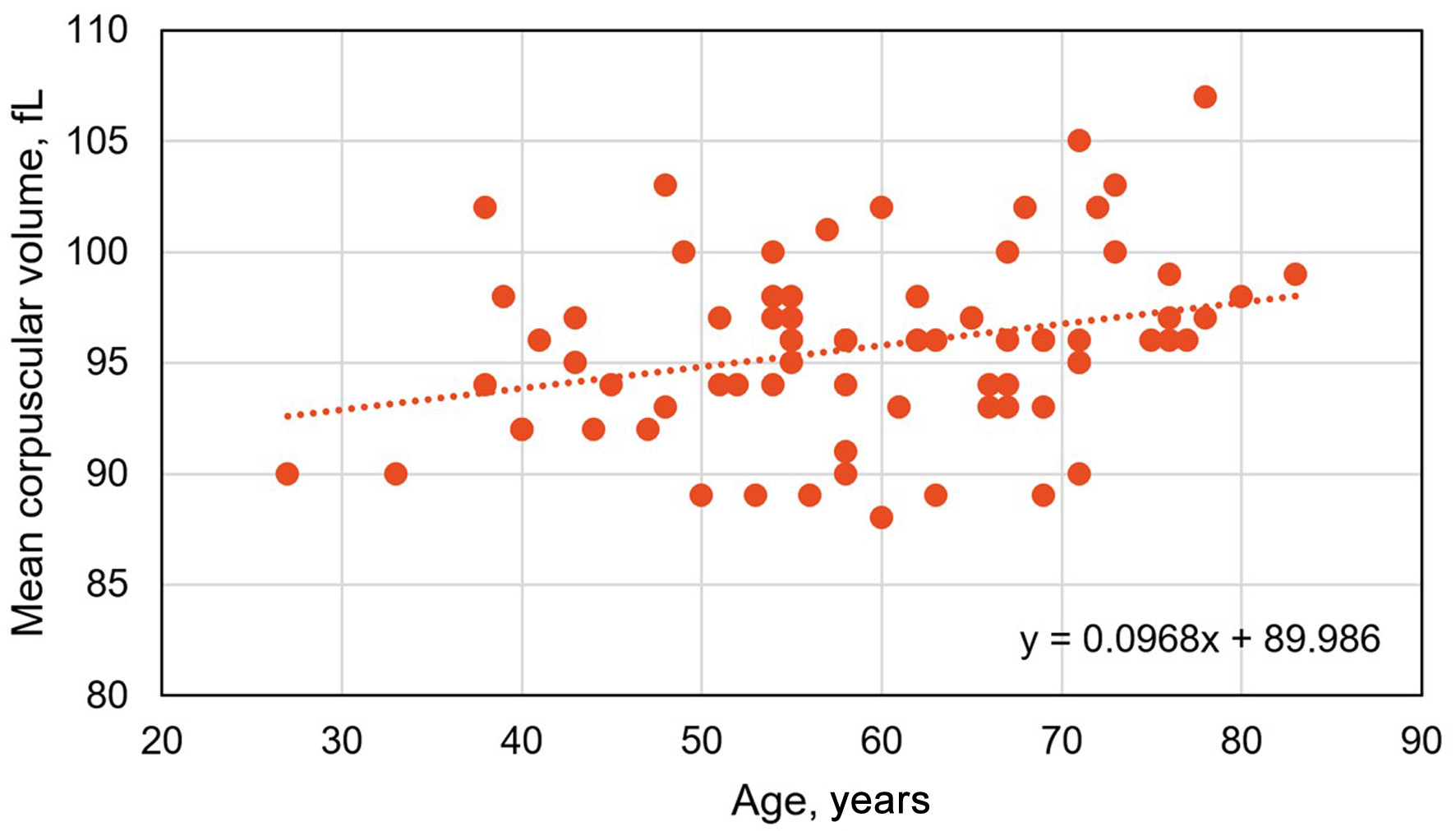
Results: There were 74 participants (37 men, 37 women) of mean age 59 ± 12 (SD) years. Mean screening TS and SF were 65±13% and 529 ± 169 µg/L (men) and 59 ± 14% and 376 ± 195 µg/L (women). Post-screening values did not differ significantly. Mean MCV was 95.7 ± 4.0 fL. There was a negative correlation of MCV with BMI (P = 0.0488) and positive correlations of MCV with age (P = 0.0098), daily heme iron intake (P = 0.0333), and daily alcohol intake (P = 0.0113). Mean MCVs of 19 participants with and 55 without heavy alcohol intake were 97.8 ± 3.8 fL and 95.0 ± 3.9 fL, respectively; P = 0.0074). Linear regression on MCV confirmed positive associations with age (P = 0.0064) and daily alcohol intake (P = 0.0151). MCV was not significantly associated with sex, diabetes, daily intakes of non-heme and supplemental iron, swollen or tender second/third MCP joints, reports of therapeutic phlebotomy, TS, or SF.
Conclusion: MCV in HFE p.C282Y/p.H63D compound heterozygotes with high iron phenotypes is positively associated with age and daily alcohol intake, after adjustment for other variables.
Published
Issue
Section
License
Copyright (c) 2026 The authors

This work is licensed under a Creative Commons Attribution 4.0 International License.