Post-Transplant Cyclophosphamide-Based Related Haploidentical Transplantation for Adult Diamond-Blackfan Anemia: Long-Term Survival and Review
DOI:
https://doi.org/10.14740/jh2220Keywords:
Diamond-Blackfan anemia, Adult, PT-Cy, PBSCT, Haploidentical, Non-malignant, Long-term survivalAbstract
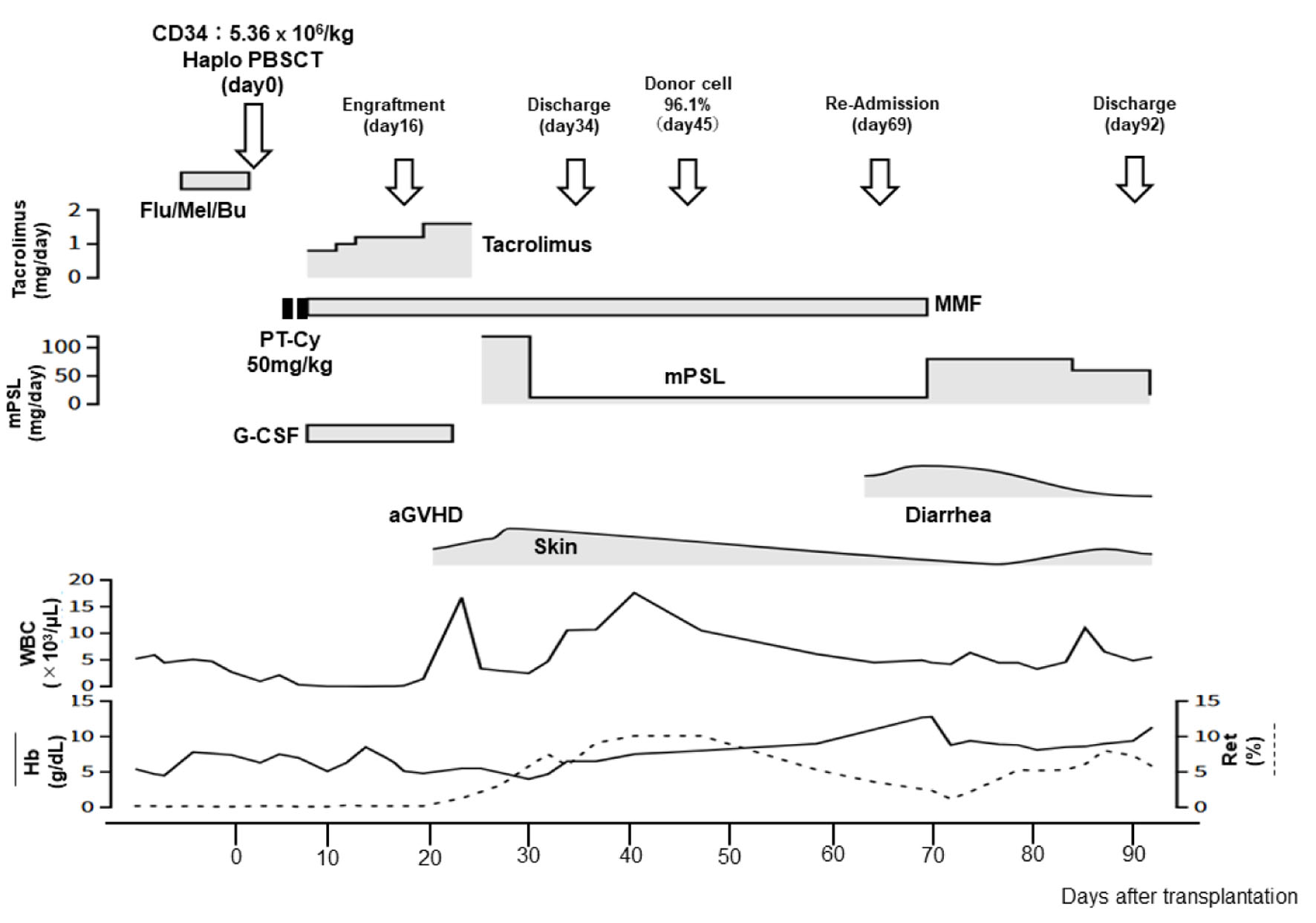
Diamond-Blackfan anemia (DBA) is a congenital bone marrow failure syndrome (CBMFS) primarily managed with corticosteroids and blood transfusions; however, allogeneic hematopoietic stem cell transplantation (allo-HSCT) remains the sole curative option when these therapies fail or relapse occurs. We report the case of a 21-year-old woman diagnosed with DBA caused by an RPS19 mutation shortly after birth. Although she responded well to corticosteroid therapy until 18 years of age, discontinuation led to relapse and subsequent transfusion dependence, necessitating allogeneic transplantation. In the absence of a human leukocyte antigen (HLA)-matched donor, she underwent post-transplantation cyclophosphamide (PT-Cy)-based haploidentical peripheral blood stem cell transplantation (haplo-PBSCT) at 21 years of age, utilizing her father as the donor. Myeloablative conditioning was performed using fludarabine, melphalan, and busulfan. For acute graft-versus-host disease (GVHD) prophylaxis, PT-Cy (50 mg/kg on days 3 and 4), tacrolimus, and mycophenolate mofetil were administered, resulting in successful neutrophil engraftment on day 16 post-transplantation. Although the patient developed acute GVHD (grade II), it resolved with corticosteroid therapy. Post-discharge, she was readmitted due to acute gastrointestinal GVHD (grade II), which improved after methylprednisolone administration. She was discharged on day 92 and achieved complete transfusion independence for the past 5 years, making this the first reported case of long-term survival following PT-Cy-based haplo-PBSCT for this condition. Including our patient, there are only four reported cases of allo-HSCT using PT-Cy for adult patients with DBA; notably, all patients survived without developing severe GVHD or infectious complications. Generally, transplant outcomes for DBA worsen with increasing age due to severe GVHD and organ damage secondary to long-term iron overload. Given that DBA is a non-malignant disease, meticulous attention must be paid to prevent unnecessary GVHD and graft failure. In adult patients with DBA, PT-Cy yielded successful engraftment and safety, with no incidence of severe GVHD, leading to long-term survival and minimal complications. These findings suggest that allo-HSCT utilizing PT-Cy remarkably expands donor options for congenital bone marrow failure syndromes. Consequently, this approach is expected to become a promising therapeutic strategy not only for hematologic malignancies but also for non-malignant disorders.
Published
Issue
Section
License
Copyright (c) 2026 The authors

This work is licensed under a Creative Commons Attribution 4.0 International License.