

Higher Relapse Rate and Resource Utilization With Ara-C Consolidation Chemotherapy Alone Compared to Hematopoietic Cell Transplantation in First Remission in a Cohort of Younger Adults With Acute Myeloid Leukemia With t(8;21) (q22;q22.1)
DOI:
https://doi.org/10.14740/jh2203Keywords:
Acute myeloid leukemia, t(8, 21), Core-binding factor AML, Autologous Hematopoietic cell transplantation, Allogeneic hematopoietic cell transplantation, High-dose cytarabine, Post-remission therapy, Relapse, Resource utilizationAbstract
Background: Acute myeloid leukemia (AML) with t(8;21) is generally classified as favorable-risk AML, with high-dose cytarabine consolidation considered standard post-remission therapy (PRT). However, relapse rates remain substantial in some populations, raising uncertainty about whether transplantation in first complete remission may benefit selected patients.
Methods: We performed a retrospective analysis of 59 patients with AML t(8;21) treated entirely at a single tertiary institution. Patients received standard induction chemotherapy followed by PRT with high-dose cytarabine chemotherapy, autologous hematopoietic cell transplantation, or allogeneic hematopoietic cell transplantation. Survival outcomes, relapse incidence, prognostic factors, non-relapse mortality, and healthcare resource utilization were analyzed.
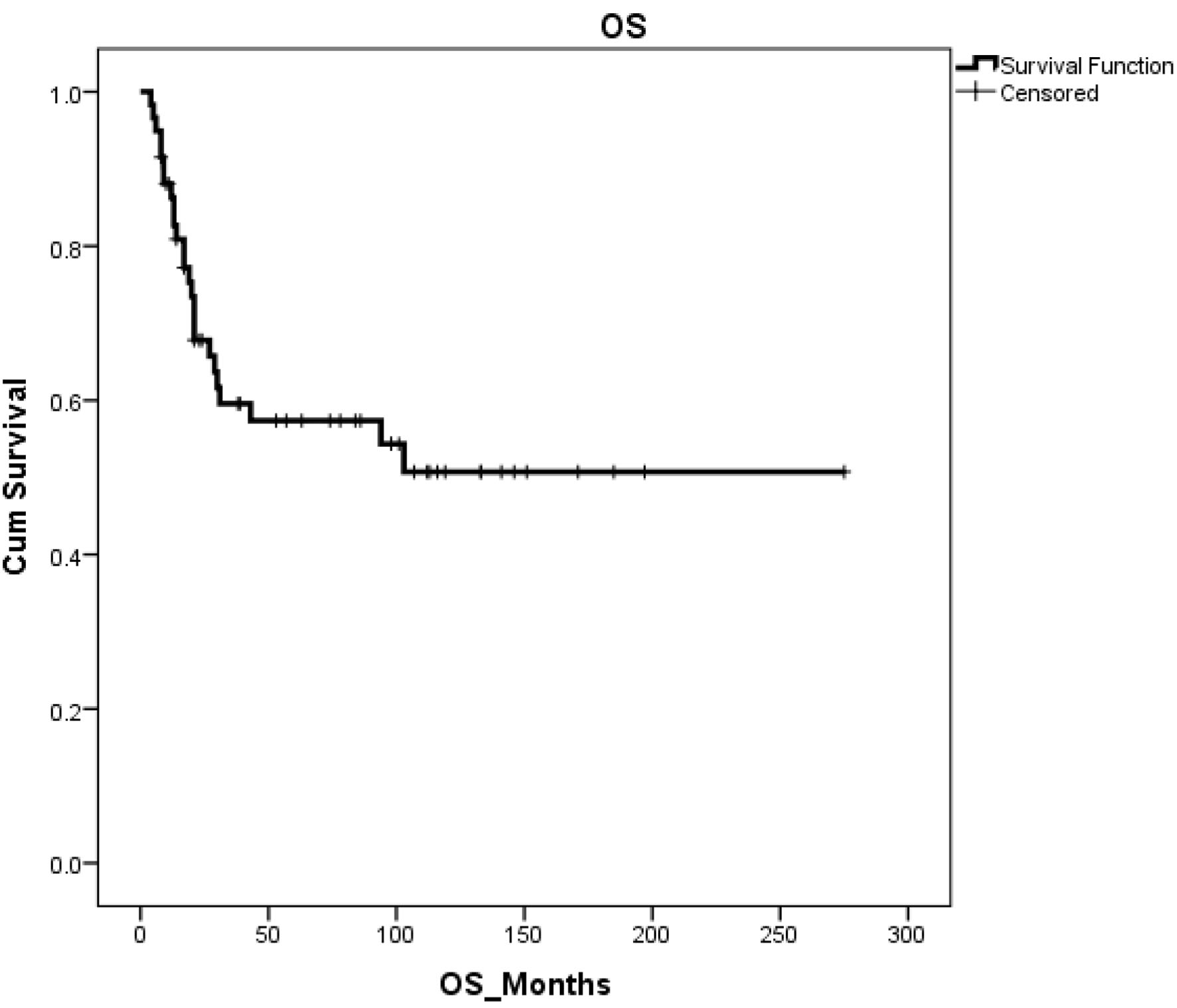
Results: The median age was 23 years, and 93% achieved complete remission after induction therapy. The 10-year event-free survival and overall survival for the entire cohort were 47% and 50%, respectively. A white blood cell count < 20 × 109/L and diagnosis after 2005 were independently associated with improved overall survival. Among 49 patients receiving adequate PRT in first remission, relapse was significantly higher with high-dose cytarabine alone compared with transplantation: 5-year cumulative incidence of relapse was 71.1% versus 31.6%, respectively. Five-year overall survival was 55.9% with high-dose cytarabine, 77.5% with autologous transplantation, and 64.6% with allogeneic transplantation. Autologous transplantation was associated with lower first-year cost and reduced bed utilization.
Conclusion: In this cohort of predominantly young Middle Eastern patients with AML t(8;21), outcomes with high-dose cytarabine consolidation alone were modest, with an unexpectedly high relapse rate. Transplantation in first remission, particularly autologous transplantation, appeared feasible, safe, cost-effective, and associated with lower relapse risk. Prospective studies incorporating molecular risk stratification, minimal residual disease monitoring, gemtuzumab ozogamicin, quality-of-life assessment, and cost-effectiveness analyses are warranted.
Published
Issue
Section
License
Copyright (c) 2026 The authors

This work is licensed under a Creative Commons Attribution 4.0 International License.