


Could the Immune Modulation of Invariant Natural Killer T Cell and the Expression of CD244 and CD196 on Natural Killer Cell Subtypes Impact the Treatment Outcomes of Acute Myeloid Leukemia Patients?
DOI:
https://doi.org/10.14740/jh2209Keywords:
Natural killer cells, Invariant natural killer T cells, CD244, CD196, AML, SDG3Abstract
Background: The present study aimed to assess the CCR6 and CD244 expression on natural killer (NK) and natural killer T (NKT) cells, considering their different subsets and examining their associations with molecular cytogenetics and clinical outcomes in newly diagnosed adult acute myeloid leukemia (AML) patients.
Methods: We recruited 26 new cases of newly diagnosed adult AML and 24 adult healthy participants as controls, after diagnosis of AML, bone marrow studies, cytogenetics, and molecular studies; samples of peripheral blood were collected from all participants for flow cytometry to determine the expressions of CD244 and CD196.
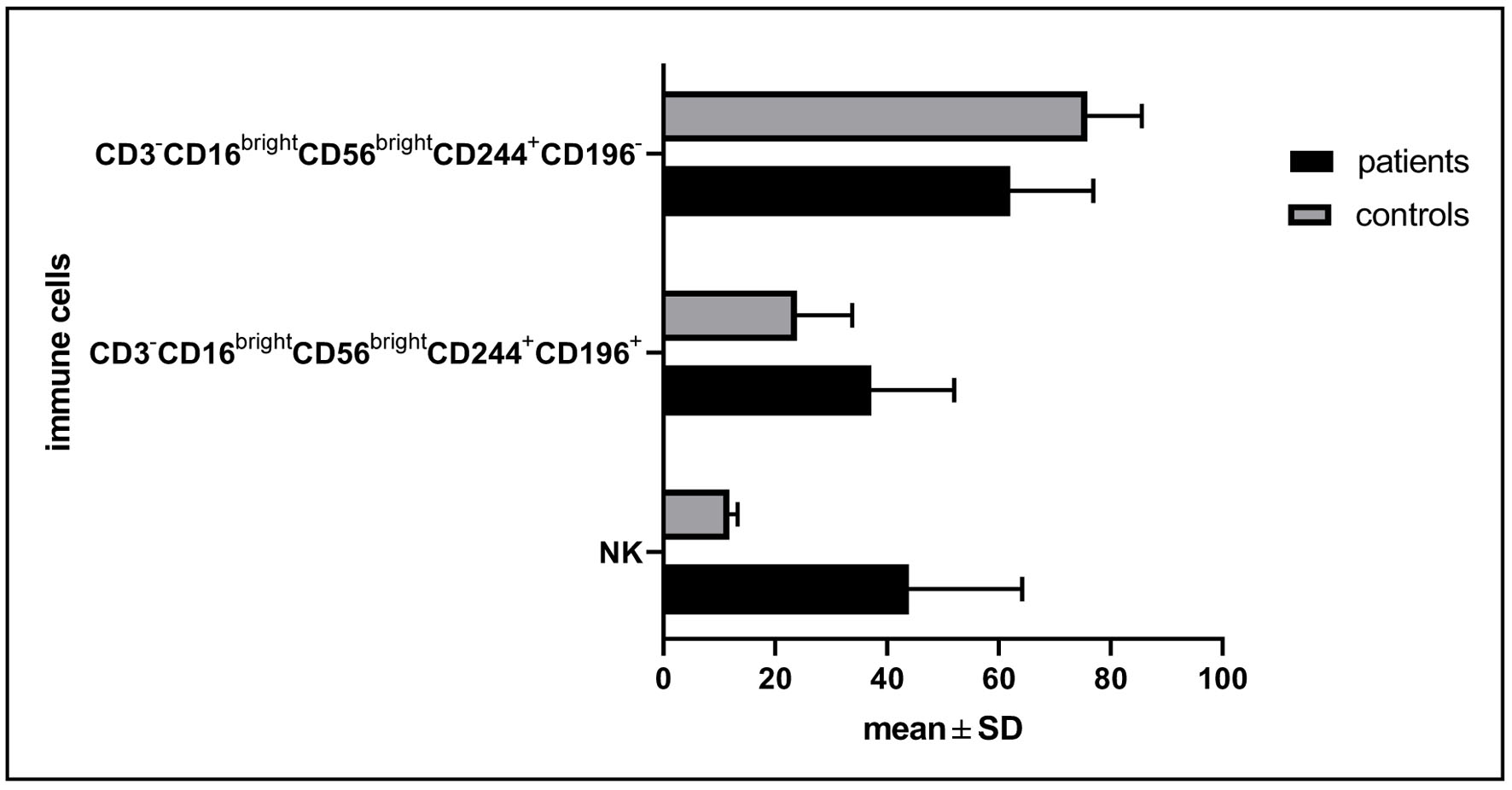
Results: Invariant NKT cells were significantly more abundant in controls than in patients. In patients, CD244 expression was associated with increased accumulation of NKT cells, whereas CD196+ NKT cells were more frequently found in controls. Regarding CD3− NK cells, co-expression of CD244 and CD196 was significantly increased in patients compared with controls across all CD3− NK subpopulations. CD244 expression was higher in controls, within CD16brightCD56bright NK, CD16brightCD56dim NK, and CD16dimCD56bright NK subsets. In contrast, in patients’ CD16+CD56− NK cells, CD196 showed an inverse pattern: it was expressed more in patients with CD16brightCD56dim NK cells, compared with controls’ CD16+CD56− and CD16−CD56+ NK cells. Dim CD56 expression on NK cells, regardless of CD16 level, was associated with treatment remission. In addition, the presence of CD244 and/or CD196 was linked to treatment failure, whereas the dual absence of CD244 and CD196 was associated with remission.
Conclusion: The expression pattern of CD244 (2B4 receptor) and CD196 on NK and NKT cells was generally associated with remission status and prognostic features of AML patients.
Published
Issue
Section
License
Copyright (c) 2026 The authors

This work is licensed under a Creative Commons Attribution 4.0 International License.