Journal of Hematology, ISSN 1927-1212 print, 1927-1220 online, Open Access
Article copyright, the authors; Journal compilation copyright, J Hematol and Elmer Press Inc
Journal website https://jh.elmerpub.com

Review

Volume 15, Number 5, October 2026, pages 219-224


Heterogeneity in Infection Reporting Across Covalent Bruton Tyrosine Kinase Inhibitor Studies in B-Cell Malignancies: A Systematic Review

Figure

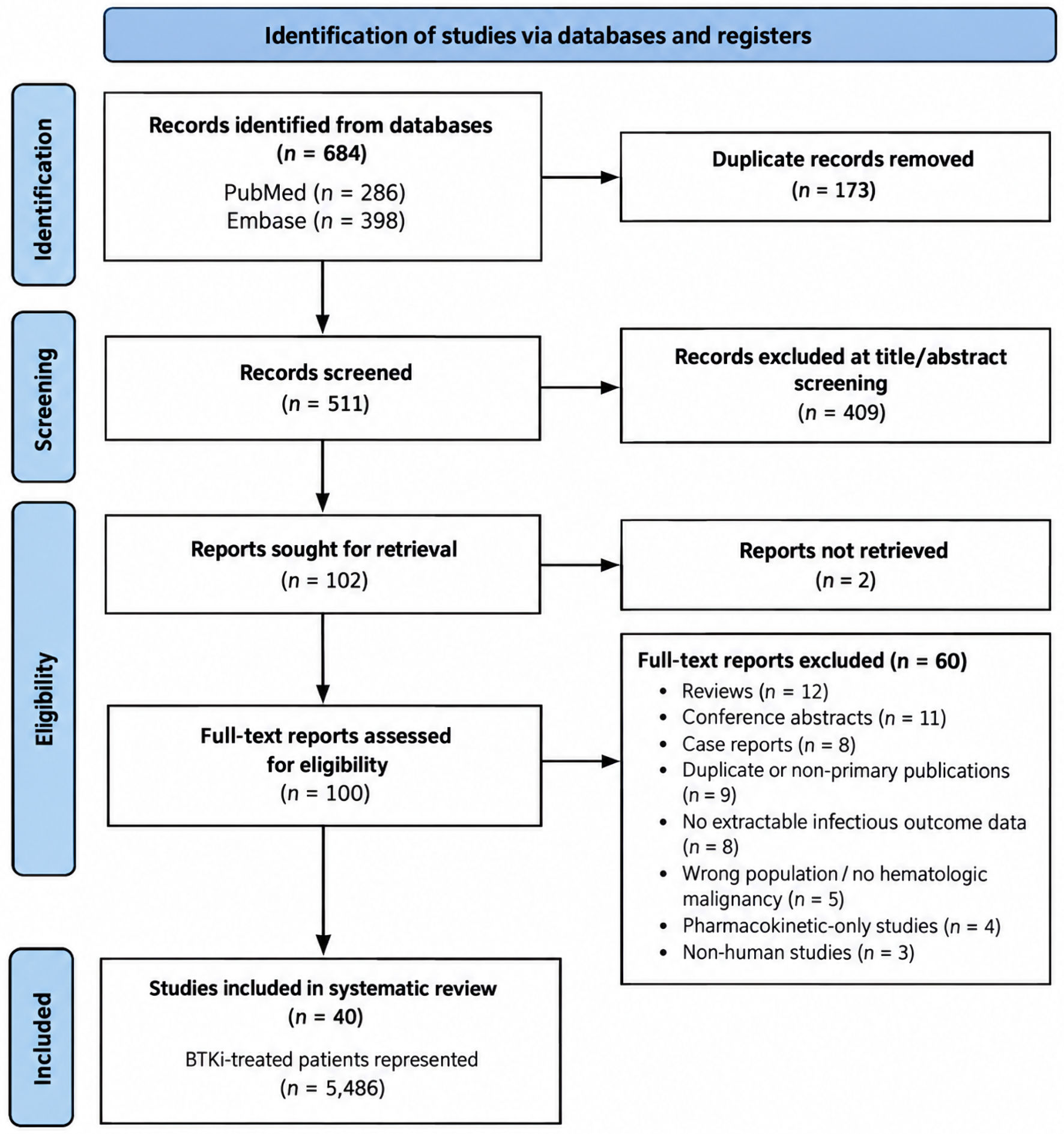
↓  Figure 1. PRISMA flow diagram of study selection. Flow diagram showing identification, screening, eligibility assessment, and inclusion of studies evaluating infectious outcomes among patients with B-cell malignancies receiving covalent Bruton tyrosine kinase inhibitors (BTKis). PRISMA: Preferred Reporting Items for Systematic Reviews and Meta-Analyses.
Figure 1.

Tables

↓  Table 1. Characteristics of Included BTKi Studies
 
CharacteristicAll studies (n = 40)Phase 1 (n = 21)Phase 3 (n = 14)
Percentages represent the proportion of included studies reporting each characteristic rather than the proportion of individual patients. BTKi: Bruton’s tyrosine kinase inhibitor; CLL: chronic lymphocytic leukemia; MCL: mantle cell lymphoma.
BTKi evaluated
  Ibrutinib21 (52.5%)136
  Zanubrutinib10 (25.0%)45
  Acalabrutinib7 (17.5%)33
  Other BTKi2 (5.0%)10
Primary disease
  CLL25 (62.5%)139
  MCL10 (25.0%)63
  Other B-cell cancers5 (12.5%)22
Concomitant therapy
  None29 (72.5%)1411
  Anti-CD20 antibody11 (27.5%)73
Antimicrobial prophylaxis11 (27.5%)73


↓  Table 2. Reported Infectious Complications Across BTKi Studies, Stratified by Study Phase
 
Infection categoryAll studies n (%)Phase 1 n (%)Phase 3 n (%)
Values represent the number and percentage of studies reporting each outcome and should not be interpreted as pooled patient-level infection incidence. HSV: herpes simplex virus; VZV: varicella zoster virus; HBV: hepatitis-B virus; BTKi: Bruton’s tyrosine kinase inhibitor.
Pneumonia31 (77.5)18 (85.7)9 (64.3)
Upper respiratory tract infection29 (72.5)17 (81.0)9 (64.3)
Urinary tract infection19 (47.5)12 (57.1)5 (35.7)
Skin/soft-tissue infection10 (25.0)7 (33.3)2 (14.3)
Opportunistic infections
  Aspergillosis9 (22.5)7 (33.3)1 (7.1)
  Cryptococcosis6 (15.0)5 (23.8)1 (7.1)
  Viral reactivation (HSV, VZV, or HBV)9 (22.5)6 (28.6)2 (14.3)
Grade ≥ 3 infections (any)27 (67.5)17 (81.0)7 (50.0)
Infection-related mortality25 (62.5)14 (66.7)8 (57.1)


↓  Table 3. Recommended Reporting of Infectious Outcomes in Future BTKi Trials
 
Reporting domainInformation to report
BTKi: Bruton’s tyrosine kinase inhibitor.
Infection ascertainmentDefine each infection outcome; state whether infections were actively sought or passively reported, how they were diagnosed, and the period during which they were recorded.
Infection type and severityReport all-grade and grade ≥ 3 infections; name the infection site and organism when known; identify opportunistic infections; specify the grading system and its version.
Denominators and timingGive the number of BTKi-exposed patients at risk in each treatment group, number of patients affected, and number of events where relevant. Report treatment duration, follow-up, and timing of infections relative to BTKi initiation.
Patient and treatment contextReport underlying malignancy and treatment setting, prior anticancer therapy and transplant history, baseline immune status where available, corticosteroid use, and concurrent anticancer or other immunosuppressive treatment.
Infection preventionDescribe antibacterial, antiviral, and antifungal prophylaxis, including who received it and when; report relevant vaccination or infection-prevention policies.
Infection-related mortalityReport deaths attributed to infection separately from all-cause deaths and describe how infection attribution was determined.