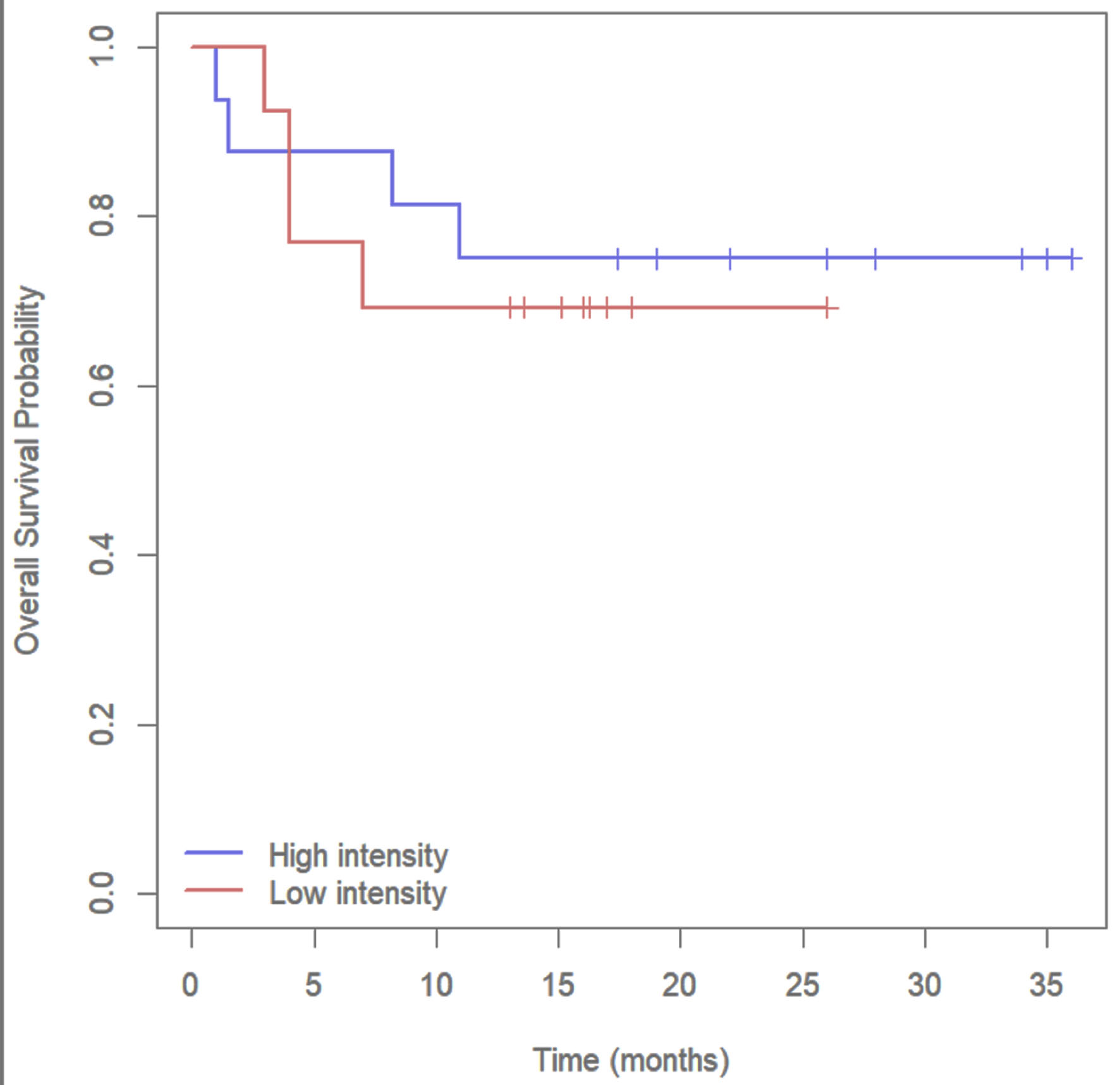
↓ Figure 1. Kaplan–Meier estimates of overall survival in the intensive chemotherapy versus azacitidine-venetoclax cohorts (P = 0.7).
| Journal of Hematology, ISSN 1927-1212 print, 1927-1220 online, Open Access |
| Article copyright, the authors; Journal compilation copyright, J Hematol and Elmer Press Inc |
| Journal website https://jh.elmerpub.com |
Original Article
Volume 15, Number 4, August 2026, pages 179-187
The Impact of Induction With Azacitidine and Venetoclax Versus Intensive Chemotherapy on Outcomes After Allogeneic Hematopoietic Cell Transplantation for Newly Diagnosed Acute Myeloid Leukemia
Figure
Tables
| Patient characteristics | Intensive chemotherapy (N = 17) | Azacitidine-venetoclax (N = 14) | P-value |
|---|---|---|---|
| HCT-CI: Hematopoietic Cell Transplantation Comorbidity Index. | |||
| Gender | 0.55 | ||
| Female | 9 (53%) | 5 (36%) | |
| Male | 8 (47%) | 9 (64%) | |
| Age at transplant, median (range) years | 63 (54–66) | 67 (61–69) | 0.13 |
| Karnofsky Performance status | 0.7 | ||
| 90% or greater | 4 (24%) | 2 (14%) | |
| Less than 90% | 13 (76%) | 12 (86%) | |
| HCT-CI | 0.7 | ||
| Less than 3 | 14 (82%) | 10 (71%) | |
| 3 or more | 3 (18%) | 4 (29%) | |
| Acute myeloid leukemia type | 0.15 | ||
| De novo | 16 (94%) | 10 (71%) | |
| Secondary | 1 (6%) | 4 (29%) | |
| European Leukemia Network risk | 0.001 | ||
| Adverse | 7 (41%) | 13 (93%) | |
| Intermediate | 9 (53%) | 0 (0%) | |
| Favorable | 1 (6%) | 1 (7%) | |
| Disease Risk Index | 0.02 | ||
| Very high | 0 (0%) | 4 (29%) | |
| High | 15 (88%) | 10 (71%) | |
| Intermediate | 2 (12%) | 0 (0%) | |
| Minimal residual disease at transplant | 0.4 | ||
| Yes | 4 (24%) | 6 (43%) | |
| No | 13 (76%) | 8 (57%) | |
| Transplant conditioning intensity | 0.2 | ||
| Myeloablative | 3 (18%) | 0 (0%) | |
| Reduced intensity | 14 (82%) | 14 (100%) | |
| Donor type | 0.4 | ||
| Matched unrelated | 9 (53%) | 8 (57%) | |
| Mismatch unrelated | 1 (6%) | 3 (21.5%) | |
| Haploidentical | 4 (23.5%) | 3 (21.5%) | |
| Matched related | 3 (17.5%) | 0 (0%) | |
| Outcome after stem-cell transplant | Intensive chemotherapy | Azacitidine-venetoclax | P-value |
|---|---|---|---|
| CR: complete remission; MRD: minimal residual disease. | |||
| Complete remission at day 100 posttransplant | 0.7 | ||
| CR/MRD negative | 12 (71%) | 12 (86%) | |
| CR/MRD positive | 2 (12%) | 1 (7%) | |
| Relapsed/deceased | 3 (17%) | 1 (7%) | |
| Acute graft-versus-host disease | 0.6 | ||
| Grade 0 | 4 (23.5%) | 6 (43%) | |
| Grade I–II | 9 (53%) | 6 (43%) | |
| Grade III–IV | 4 (23.5%) | 2 (14%) | |
| Chronic graft-versus-host disease | 0.2 | ||
| None | 7 (41%) | 11 (79%) | |
| Limited | 5 (29%) | 1 (7%) | |
| Extensive | 3 (18%) | 1 (7%) | |
| Deceased | 2 (12%) | 1 (7%) | |
| Relapse | > 0.9 | ||
| Yes | 3 (18%) | 3 (21%) | |
| No | 14 (82%) | 11 (79%) | |
| Deceased | > 0.9 | ||
| Yes | 4 (24%) | 4 (29%) | |
| No | 13 (76%) | 10 (71%) | |
| Estimate at 1-year | Intensive chemotherapy | Azacitidine-venetoclax | P value |
|---|---|---|---|
| CI: confidence interval; GVHD: graft-versus-host disease; GRFS: GVHD-free, relapse-free survival. | |||
| Overall survival (95% CI) | 75% (56.5–99.5) | 69.2% (48.2–99.5) | 0.73 |
| Relapse-free survival (95% CI) | 64.7% (45.5–91.9) | 57.1% (36.3–89.9) | 0.67 |
| Cumulative incidence of non-relapse mortality (%) | 23.5 | 28.5 | 0.76 |
| Cumulative incidence of relapse (%) | 11.8 | 14.3 | 0.84 |
| Cumulative incidence of acute GVHD II–IV (%) | 23.5 | 35.7 | 0.48 |
| Cumulative incidence of acute GVHD III–IV (%) | 5.9 | 14.3 | 0.46 |
| Cumulative incidence of chronic GVHD (%) | 11.8 | 7.1 | 0.67 |
| GRFS (95% CI) | 64.7% (45.5–91.9) | 57.1% (36.3–89.9) | 0.67 |