| Journal of Hematology, ISSN 1927-1212 print, 1927-1220 online, Open Access |
| Article copyright, the authors; Journal compilation copyright, J Hematol and Elmer Press Inc |
| Journal website https://jh.elmerpub.com |
Case Report
Volume 15, Number 4, August 2026, pages 214-218

Post-Transplant Cyclophosphamide-Based Related Haploidentical Transplantation for Adult Diamond-Blackfan Anemia: Long-Term Survival and Review
Tomohiro Sakakibaraa, Sumiko Kobayashia, d  , Toshiro Itob, Moriaki Tachibanaa, Eturo Itoc
aDepartment of Hematology, Tokyo Metropolitan Institute for Geriatrics and Gerontology, Tokyo, Japan
bDepartment of Hematology, National Hospital Organization Matsumoto Medical Center, Matsumoto, Nagano, Japan
cDepartment of Community Medicine, Hirosaki University Graduate School of Medicine, Hirosaki, Aomori, Japan
dCorresponding Author: Sumiko Kobayashi, Department of Hematology, Tokyo Metropolitan Institute for Geriatrics and Gerontology, Tokyo, Japan
Manuscript submitted June 12, 2026, accepted August 4, 2026, published online August 31, 2026
Short title: PT-Cy Haplo-PBSCT for Adult DBA
doi: https://doi.org/10.14740/jh2220
| Abstract | ▴Top |
Diamond-Blackfan anemia (DBA) is a congenital bone marrow failure syndrome (CBMFS) primarily managed with corticosteroids and blood transfusions; however, allogeneic hematopoietic stem cell transplantation (allo-HSCT) remains the sole curative option when these therapies fail or relapse occurs. We report the case of a 21-year-old woman diagnosed with DBA caused by an RPS19 mutation shortly after birth. Although she responded well to corticosteroid therapy until 18 years of age, discontinuation led to relapse and subsequent transfusion dependence, necessitating allogeneic transplantation. In the absence of a human leukocyte antigen (HLA)-matched donor, she underwent post-transplantation cyclophosphamide (PT-Cy)-based haploidentical peripheral blood stem cell transplantation (haplo-PBSCT) at 21 years of age, utilizing her father as the donor. Myeloablative conditioning was performed using fludarabine, melphalan, and busulfan. For acute graft-versus-host disease (GVHD) prophylaxis, PT-Cy (50 mg/kg on days 3 and 4), tacrolimus, and mycophenolate mofetil were administered, resulting in successful neutrophil engraftment on day 16 post-transplantation. Although the patient developed acute GVHD (grade II), it resolved with corticosteroid therapy. Post-discharge, she was readmitted due to acute gastrointestinal GVHD (grade II), which improved after methylprednisolone administration. She was discharged on day 92 and achieved complete transfusion independence for the past 5 years, making this the first reported case of long-term survival following PT-Cy-based haplo-PBSCT for this condition. Including our patient, there are only four reported cases of allo-HSCT using PT-Cy for adult patients with DBA; notably, all patients survived without developing severe GVHD or infectious complications. Generally, transplant outcomes for DBA worsen with increasing age due to severe GVHD and organ damage secondary to long-term iron overload. Given that DBA is a non-malignant disease, meticulous attention must be paid to prevent unnecessary GVHD and graft failure. In adult patients with DBA, PT-Cy yielded successful engraftment and safety, with no incidence of severe GVHD, leading to long-term survival and minimal complications. These findings suggest that allo-HSCT utilizing PT-Cy remarkably expands donor options for congenital bone marrow failure syndromes. Consequently, this approach is expected to become a promising therapeutic strategy not only for hematologic malignancies but also for non-malignant disorders.
Keywords: Diamond-Blackfan anemia; Adult; PT-Cy; PBSCT; Haploidentical; Non-malignant; Long-term survival
| Introduction | ▴Top |
Diamond-Blackfan anemia (DBA) is a congenital bone marrow failure syndrome (CBMFS) caused by genetic mutations, typically represented by RPS19 mutations, and is characterized by pure red cell aplasia that usually presents in infancy. Standard treatment involves red blood cell (RBC) transfusions and corticosteroid therapy [1, 2]. Approximately 80% of patients initially respond to corticosteroids, and 60–70% eventually become transfusion-independent. However, patients who are refractory to these treatments are candidates for allogeneic hematopoietic stem cell transplantation (allo-HSCT), which remains the only curative option for this disease [1, 2]. In recent years, haploidentical transplantation using post-transplant cyclophosphamide (PT-Cy) has emerged as an alternative donor strategy for hematologic malignancies when matched donors are unavailable [3, 4]. However, its application in DBA, particularly in adult patients with infant-onset disease, remains extremely limited [5–7]. We herein report a case of infant-onset DBA successfully treated with haploidentical peripheral blood stem cell transplantation (PBSCT) with PT-Cy in adulthood, in which well-controlled graft-versus-host disease (GVHD) and sustained erythropoiesis were achieved for more than 5 years.
| Case Report | ▴Top |
A 26-year-old woman with DBA caused by an RPS19 mutation (c.356 +1G>A), who was diagnosed at 3 months of age was admitted for allo-HSCT. Following the diagnosis, she achieved remission with prednisolone and cyclosporine therapy, which was discontinued at 18 years of age. However, anemia relapsed at 19 years of age. Although prednisolone was reintroduced, she remained transfusion-dependent. At 20 years of age, she developed steroid-induced psychosis while receiving prednisolone at another hospital, leading to the gradual discontinuation of steroid therapy. Thereafter, she required red blood cell transfusions every week. At 21 years of age, she was referred to our institution for allo-HSCT. On initial evaluation, the laboratory analysis revealed severe anemia with a hemoglobin (Hb) level of 46 g/L and a reticulocyte count of 0.1%. No congenital malformations were observed. Although the patient was registered with the Japan Marrow Donor Program, no suitable donor was identified. Then, her father was chosen as a donor in whom human leukocyte antigen (HLA) was matched and the RPS19 mutation was absent. Despite the high ferritin level (2,824 ng/mL), echocardiography showed a preserved cardiac function with an ejection fraction of 72.1%, and liver function tests were within the normal range. Although the donor was an HLA haploidentical, GVHD and graft failure were a major concern in the setting of PBSCT from the parent. Therefore, PT-Cy was introduced as a GVHD prophylaxis, replacing the conventional approach. The conditioning regimen consisted of fludarabine (150 mg/m2), melphalan (140 mg/m2), and busulfan (6.4 mg/kg) as a myeloablative conditioning (MAC) regimen. PT-Cy (50 mg/kg) was administered on days 3 and 4. Tacrolimus (0.02 mg/kg/day) and mycophenolate mofetil (MMF 1,750 mg/day) were initiated on day 5 for GVHD prophylaxis (Fig. 1). Neutrophil engraftment was achieved on day 16, followed by RBC and platelet engraftments on day 20 and day 31, respectively. On day 17, the patient developed grade II acute skin GVHD, and tacrolimus was discontinued because its blood concentration failed to reach the therapeutic range despite a threefold dose escalation during the transplant period, demonstrating a lack of efficacy. Instead, the immunosuppressive regimen was switched to methylprednisolone with MMF as JAK2 inhibitors were unavailable at that time, leading to her discharge on day 34 (Supplementary Material 1, jh.elmerpub.com). The patient achieved full donor chimerism (96.1%) on day 45, as confirmed by sex-mismatched fluorescence in situ hybridization (FISH) using bone marrow samples and no longer required transfusion after engraftment. On day 69, the patient was readmitted with grade II acute gastrointestinal-GVHD (GI-GVHD). Given the potential for malabsorption of methylprednisolone and MMF due to watery diarrhea, we stopped MMF and steroids were switched to intravenous administration methylprednisolone monotherapy to ensure rapid efficacy. Her condition improved, leading to her second discharge on day 92. At 5 years after transplantation, the trilineage hematopoiesis remains stable, transfusional iron overload has improved, and the patient has achieved complete social reintegration.
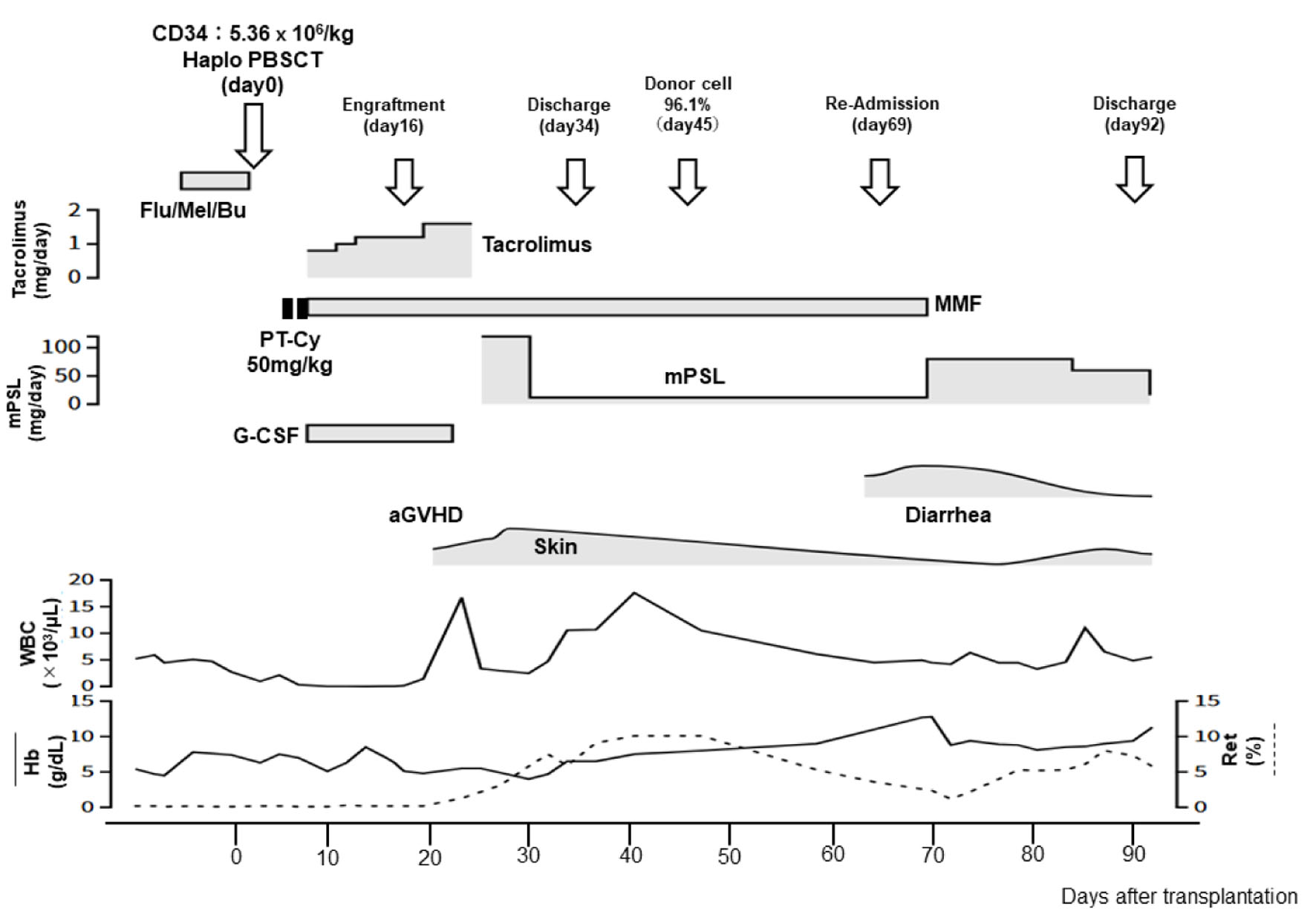 Click for large image | Figure 1. Clinical course of the patient. Adult DBA engrafted after related PT-Cy haplo-PBSCT. Acute skin GVHD developed. However, tacrolimus was discontinued due to malabsorption failing to reach therapeutic levels, and GVHD was managed with methylprednisolone and MMF. GI-GVHD precluded oral medication absorption, requiring management with methylprednisolone monotherapy. After engraftment, the patient achieved complete independence from RBC transfusions. aGVHD: acute graft-versus-host disease; Bu: busulfan (6.4 mg/kg); DBA: Diamond-Blackfan anemia; Flu: fludarabine (150 mg/m2); G-CSF: granulocyte-colony stimulating factor; haplo-PBSCT: haploidentical peripheral blood stem cell transplantation; Hb: hemoglobin; Mel: melphalan (140 mg/m2); MMF: mycophenolate mofetil; mPSL: methylprednisolone; PT-Cy: posttransplant-cyclophosphamide; ret: reticulocyte count; WBC: white blood cell. |
| Discussion | ▴Top |
Previous reports have indicated that favorable outcomes in allogeneic HSCT for DBA are associated with age at transplantation of <10 years, use of an HLA-matched donor, MAC regimen, and bone marrow as the stem cell source [1, 2, 5, 7, 8]. Because older patients are considered to have a longer history of blood transfusions, thereby predisposing them to a higher risk of complications. In addition, matched unrelated donor transplantation has been associated with a higher incidence of chronic GVHD, particularly in children ≥ 10 years of age. Because HLA-matched sibling donors are still considered the preferred donor source for HSCT in patients with DBA [9–11]. Arcuri et al demonstrated the efficacy of myeloablative PBSCT incorporating PT-Cy [12]. The current case diverged significantly from these conventional reports; the patient was 21 years of age and underwent HLA-haploidentical transplantation using peripheral blood stem cells (PBSCs). Nevertheless, the patient has successfully overcome the disease and maintained a stable clinical state for more than 5 years post-transplant. Regarding conditioning regimens, the MAC regimen has traditionally been considered the standard approach for DBA. However, a recent retrospective study involving 27 patients with DBA reported no significant difference in transplantation outcomes between MAC and reduced-intensity conditioning (RIC) regimens, with overall survival rates of 100% and 92.9%, respectively [10, 11]. In stem cell source, for non-malignant diseases, bone marrow is generally preferred over PBSCs because of the lower risk of chronic GVHD [11]. In the present case, however, no suitable matched donor was available. Therefore, haploidentical PBSCT from a related donor was selected. Currently, HLA-haploidentical transplantation with PT-Cy is primarily performed for hematologic malignancies [3, 4]. PT-Cy effectively prevents severe GVHD by eliminating alloreactive T cells while preserving immune reconstitution. However, the optimal dose of cyclophosphamide, particularly in pediatric and young adult populations, has not yet been fully established. Reports from the early 2000s the survival rate for HLA-mismatched donors was extremely low at approximately 23%, and transplantation in adult patients was not recommended at that time in adult DBA [1]. However, the present case demonstrates that the introduction of PT-Cy has enabled haploidentical transplantation (historically associated with high mortality) to be performed safely, even in adult patients with DBA [12–14]. Fuji et al reported a retrospective analysis comparing standard-dose PT-Cy (100 mg/kg) with reduced-dose PT-Cy (80 mg/kg) and found no significant differences in the incidence of acute GVHD (grade II–IV: 29.2% vs. 25.3%; grade III–IV: 7.3% vs. 6.6%) or chronic GVHD [15]. In contrast, Hernandez et al reported on PT-Cy haploidentical transplantation for CBMFS, including DBA. In their study, a cyclophosphamide (Cy) dose of 25 mg/kg led to grade IV acute GVHD in two patients with Fanconi anemia, while two patients with DBA died from engraftment failure [16]. Following these results, the Cy dose was subsequently adjusted to 50 mg/kg. Therefore, it is prudent to reduce the Cy dosage with utmost caution. These findings suggest that optimization of PT-Cy dosing, taking into account long-term cardiotoxicity and fertility, remains an important area for future investigation. To the best of our knowledge, including our case, a total of four cases of allo-HSCT using PT-Cy for adult DBA have been reported [13, 14]. Table 1 summarizes these cases. A common feature among them is that all patients achieved successful engraftment, experienced neither severe GVHD nor significant infections, and survived, with some achieving long-term survival. Although transplantation outcomes for adult DBA are generally known to decline with advancing age, the use of PT-Cy-based transplantation holds promise for improving these outcomes. Future challenges remain regarding whether MAC or RIC is the optimal conditioning regimen, and whether bone marrow or PBSCs remains the preferred graft source, warranting further investigation. Nevertheless, it has become increasingly evident that PT-Cy haploidentical transplantation can ensure safety, guarantee engraftment, and control GVHD, even in the setting of HLA-mismatched transplantation [13, 17, 18]. To date, there have been no previous reports describing successful haploidentical PBSCT with PT-Cy in an adult patient with DBA who had reached adulthood. In DBA, patients ≥ 17 years of age or those undergoing transplantation with multiple HLA mismatches are considered to have a higher risk of transplant-related mortality, including GVHD-related complications [1, 7, 15–17]. In the present case, prompt engraftment was achieved, acute GVHD was well controlled, and stable hematopoiesis was maintained for more than 5 years after PBSCT. Importantly, the patient achieved complete social reintegration. The European Society for Blood and Marrow Transplantation treatment guidelines for aplastic anemia and DBA are formulated based on the presence or absence of iron overload [19]. Although there is currently no mention of the indications for haploidentical transplantation, it might be a potential therapeutic option for the future. In summary, these findings suggest that haploidentical PBSCT with PT-Cy may represent a feasible and effective alternative therapeutic option for patients with DBA, a congenital bone marrow failure syndrome caused by genetic mutations, who lack a suitable donor.
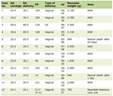 Click to view | Table 1. Reports of Post Transplant Cyclophosphamide Allogeneic Stem Cell Transplantation in Adult Diamond-Blackfan Anemia |
| Supplementary Material | ▴Top |
Suppl 1. Laboratory data during the clinical course of DBA patient.
Acknowledgments
Special thanks to Brian Quinn for revising the English language of this manuscript.
Financial Disclosure
None to declare.
Conflict of Interest
The authors declare no conflicts of interest in association with the present report.
Informed Consent
Written informed consent was obtained from the patient for publication.
Author Contributions
TS summarized the medical records of the patients. TS and SK designed the study and wrote the manuscript. TI, MT, and EI discussed the manuscript. All authors have reviewed and approved the final manuscript. EI performed and interpreted the genetic analysis.
Data Availability
The data supporting the findings of this study are available from the corresponding author upon reasonable request.
| References | ▴Top |
- Vlachos A, Federman N, Reyes-Haley C, Abramson J, Lipton JM. Hematopoietic stem cell transplantation for Diamond Blackfan anemia: a report from the Diamond Blackfan Anemia Registry. Bone Marrow Transplant. 2001;27(4):381-386.
doi pubmed - Vlachos A, Muir E. How I treat Diamond-Blackfan anemia. Blood. 2010;116(19):3715-3723.
doi pubmed - Luznik L, O'Donnell PV, Symons HJ, Chen AR, Leffell MS, Zahurak M, Gooley TA, et al. HLA-haploidentical bone marrow transplantation for hematologic malignancies using nonmyeloablative conditioning and high-dose, posttransplantation cyclophosphamide. Biol Blood Marrow Transplant. 2008;14(6):641-650.
doi pubmed - Raiola AM, Dominietto A, Ghiso A, Di Grazia C, Lamparelli T, Gualandi F, Bregante S, et al. Unmanipulated haploidentical bone marrow transplantation and posttransplantation cyclophosphamide for hematologic malignancies after myeloablative conditioning. Biol Blood Marrow Transplant. 2013;19(1):117-122.
doi pubmed - Lipton JM, Atsidaftos E, Zyskind I, Vlachos A. Improving clinical care and elucidating the pathophysiology of Diamond Blackfan anemia: an update from the Diamond Blackfan Anemia Registry. Pediatr Blood Cancer. 2006;46(5):558-564.
doi pubmed - Wilson DB, Link DC, Mason PJ, Bessler M. Inherited bone marrow failure syndromes in adolescents and young adults. Ann Med. 2014;46(6):353-363.
doi pubmed - Mugishima H, Ohga S, Ohara A, Kojima S, Fujisawa K, Tsukimoto I, Aplastic Anemia Committee of the Japanese Society of Pediatric H. Hematopoietic stem cell transplantation for Diamond-Blackfan anemia: a report from the Aplastic Anemia Committee of the Japanese Society of Pediatric Hematology. Pediatr Transplant. 2007;11(6):601-607.
doi pubmed - Strahm B, Loewecke F, Niemeyer CM, Albert M, Ansari M, Bader P, Bertrand Y, et al. Favorable outcomes of hematopoietic stem cell transplantation in children and adolescents with Diamond-Blackfan anemia. Blood Adv. 2020;4(8):1760-1769.
doi pubmed - Miano M, Eikema DJ, de la Fuente J, Bosman P, Ghavamzadeh A, Smiers F, Sengelov H, et al. Stem cell transplantation for Diamond-Blackfan anemia. A retrospective study on behalf of the severe aplastic anemia working party of the European Blood and Marrow Transplantation Group (EBMT). Transplant Cell Ther. 2021;27(3):274.e1-274.e5.
doi pubmed - Koyamaishi S, Kamio T, Kobayashi A, Sato T, Kudo K, Sasaki S, Kanezaki R, et al. Reduced-intensity conditioning is effective for hematopoietic stem cell transplantation in young pediatric patients with Diamond-Blackfan anemia. Bone Marrow Transplant. 2021;56(5):1013-1020.
doi pubmed - Bhoopalan SV, Suryaprakash S, Sharma A, Wlodarski MW. Hematopoietic cell transplantation and gene therapy for Diamond-Blackfan anemia: state of the art and science. Front Oncol. 2023;13:1236038.
doi pubmed - Arcuri LJ, Hamerschlak N, Rocha V, Bonfim C, Kerbauy MN. Outcomes after haploidentical hematopoietic cell transplantation with post-transplantation cyclophosphamide: a systematic review and meta-analysis comparing myeloablative with reduced-intensity conditioning regimens and bone marrow with peripheral blood stem cell grafts. Transplant Cell Ther. 2021;27(9):782.e781-782.e787.
doi pubmed - Leick M, Hunter B, DeFilipp Z, Dey BR, El-Jawahri A, Frigault M, McAfee S, et al. Posttransplant cyclophosphamide in allogeneic bone marrow transplantation for the treatment of nonmalignant hematological diseases. Bone Marrow Transplant. 2020;55(4):758-762.
doi pubmed - Wirk B, Deng X. Post-transplant cyclophosphamide allows allogeneic hematopoietic stem-cell transplantation across donor types for nonmalignant hematologic diseases. J Hematol. 2026;15(2):71-79.
doi pubmed - Fuji S, Nakamae H, Sugita J, Najima Y, Konishi T, Tanaka T, Nakashima Y, et al. Lower-dose post-transplant cyclophosphamide in haploidentical hematopoietic cell transplantation. Bone Marrow Transplant. 2024;59(11):1628-1630.
doi pubmed - Lopez Hernandez G, Olaya Vargas A, Ramirez Uribe RMN, Salazar Rosales HdP, Maldonado Silva K, Martinez Talavera I, Salazar Bailon JL. Different donors and conditioning regimens in hematopoietic stem cell transplantation for inherited bone marrow failure syndromes: a tale of custom-made suits. The 66th ASH Annual Meeting Abstract #721. Blood. 2024;144(Suppl 1):4868-4869.
doi - Bolanos-Meade J, Hamadani M, Wu J, Al Malki MM, Martens MJ, Runaas L, Elmariah H, et al. Post-transplantation cyclophosphamide-based graft-versus-host disease prophylaxis. N Engl J Med. 2023;388(25):2338-2348.
doi pubmed - Ruggeri A, Santoro N, Galimard JE, Kalwak K, Algeri M, Zubarovskaya L, Czyzewski K, et al. Matched unrelated donor transplantation versus haploidentical transplantation with post-transplant cyclophosphamide in children with acute myeloid leukemia: a PDWP-EBMT study. Haematologica. 2024;109(7):2122-2130.
doi pubmed - Diaz-de-Heredia C, Bresters D, Faulkner L, Yesilipek A, Strahm B, Miano M, Dalle JH, et al. Recommendations on hematopoietic stem cell transplantation for patients with Diamond-Blackfan anemia. On behalf of the Pediatric Diseases and Severe Aplastic Anemia Working Parties of the EBMT. Bone Marrow Transplant. 2021;56(12):2956-2963.
doi pubmed
This article is distributed under the terms of the Creative Commons Attribution 4.0 International License (CC BY 4.0), which permits unrestricted use, distribution, and reproduction in any medium, including commercial use, provided the original work is properly cited.
Journal of Hematology is published by Elmer Press Inc.